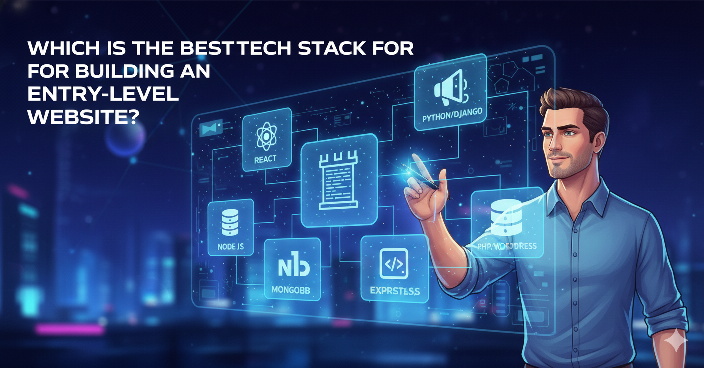
Which Is the Best Tech Stack for Building an Entry-Level Website?
With hundreds of languages, frameworks, and tools out there, deciding the right combination for an entry-level website can feel overwhelming.
But don’t worry. This guide breaks everything down simply and clearly.
Let’s explore the best tech stacks for beginners and why they matter.
What Is a Tech Stack?
A tech stack is a combination of technologies used to build a website or application.
It typically includes:
1. Frontend (Client-Side)
What users see and interact with:
HTML
CSS
JavaScript
UI frameworks (like Bootstrap, Tailwind CSS)
2. Backend (Server-Side)
What happens behind the scenes:
Server logic
Databases
Authentication
APIs
Backend technologies include languages like PHP, Python, or JavaScript (Node.js).
3. Database
Stores your website’s data.
Examples: MySQL, MongoDB, PostgreSQL.
What Do Entry-Level Websites Really Need?
Most beginner-level websites typically include:
✔ A homepage
✔ About / Services / Contact pages
✔ Simple forms
✔ Basic CMS (optional)
✔ Blogs or articles (optional)
✔ Mobile-responsive UI
✔ Fast loading performance
Since these aren’t heavy, complex requirements, you don’t need a very advanced or expensive tech stack.
Best Tech Stacks for Entry-Level Websites
Here are the top beginner-friendly tech stacks you can choose from.
1. HTML + CSS + JavaScript + Bootstrap (or Tailwind)
Best For: Static websites, landing pages, portfolios, simple business sites
This is the simplest and most reliable approach.
Why this stack is best for beginners?
Easy to learn
Fast to build
No backend needed (for simple sites)
Low cost
Lightweight and fast
You can host it anywhere—cPanel, Netlify, GitHub Pages, etc.
When to choose this?
If your website does NOT require:
❌ Login system
❌ Database
❌ Admin panel
❌ User accounts
Go for this stack.
2. WordPress (PHP + MySQL)
Best For: Blogs, corporate websites, service websites, personal brands
WordPress powers over 40% of the web because it is:
Beginner-friendly
Highly customizable
SEO-friendly
Has thousands of themes
Has unlimited plugins
Great for non-technical users
Why WordPress is perfect for entry-level websites
✔ No coding required
✔ Built-in admin panel
✔ Easy hosting
✔ Ideal for blog or content-heavy sites
✔ Fast deployment
3. PHP + Laravel + MySQL
Best For: Websites requiring custom features, CRM, membership systems
Laravel is one of the best PHP frameworks today.
Why it’s good for entry-level web apps?
Clean structure
Built-in authentication
Excellent security
Easy database management
Scalable for future growth
If you plan to upgrade your website into a full web application later, Laravel is a perfect foundation.
4. JavaScript Stack (Node.js + Express + MongoDB)
Best For: Learning modern JavaScript + building simple dynamic sites
This is great for developers who want to learn "JavaScript everywhere."
Advantages:
Same language for frontend & backend
Fast performance
Easy integration with modern frameworks
Great community support
But it might be too advanced for complete beginners.
5. JAMstack (Next.js / Nuxt.js + Headless CMS)
Best For: Modern, fast, SEO-friendly websites
JAMstack is the “new school” of web development:
Using:
Next.js or Nuxt.js
Headless CMS (like Strapi, Sanity, Ghost)
Static site generation
Why choose it?
High performance
Super SEO-friendly
Secure
Scalable
Great for blogs & business sites
But it’s slightly more complex than WordPress or plain HTML.
So, Which Tech Stack Is the Best for Entry-Level Websites?
Here’s the final comparison:
| Purpose | Recommended Stack |
|---|---|
| Simple website / Portfolio | HTML + CSS + JS + Bootstrap/Tailwind |
| Blog / Content website | WordPress (PHP + MySQL) |
| Business website with custom features | Laravel + MySQL |
| Learning full JavaScript development | Node.js + Express + MongoDB |
| High-performance modern site | Next.js + Headless CMS |
Final Recommendation
If you're looking for the easiest, fastest, and most flexible solution:
⭐ WordPress is the #1 choice for most entry-level websites.
It offers speed, simplicity, SEO benefits, and thousands of plugins.
If you want to learn coding or build something custom:
⭐ Laravel + MySQL
is the perfect balance of simplicity and scalability.
Conclusion
Choosing the right tech stack depends entirely on:
Your skill level
Your website needs
Your future plans
Your budget
A basic portfolio or business site doesn’t require a complex stack.
But if you're planning to expand into a custom web application, choose a stack that gives flexibility from day one.
Recent Posts
10 Essential SEO Tips for Small Businesses in 2025
Nov 24, 2025

The Ultimate Guide to Social Media Marketing for Startups in 2025
Nov 24, 2025

Web Development Trends to Watch in 2025
Nov 24, 2025

How to Create a Winning Digital Marketing Strategy
Nov 24, 2025

The Power of Content Marketing: Why Your Business Needs It
Nov 24, 2025